The Refugee Settlements of Alexandras Av. are the first apartment buildings ever built in Greece in order to house the Greek refugees coming from Turkey. The history in repeat.
“Photography and the body: the art of Kleopatra Haritou”
by Ian Jeffrey
What is art? We all have ideas on the subject, even if they fall apart on inspection. Maybe art is an utopian condition never quite achieved. Think of it as a trial zone or testing ground.
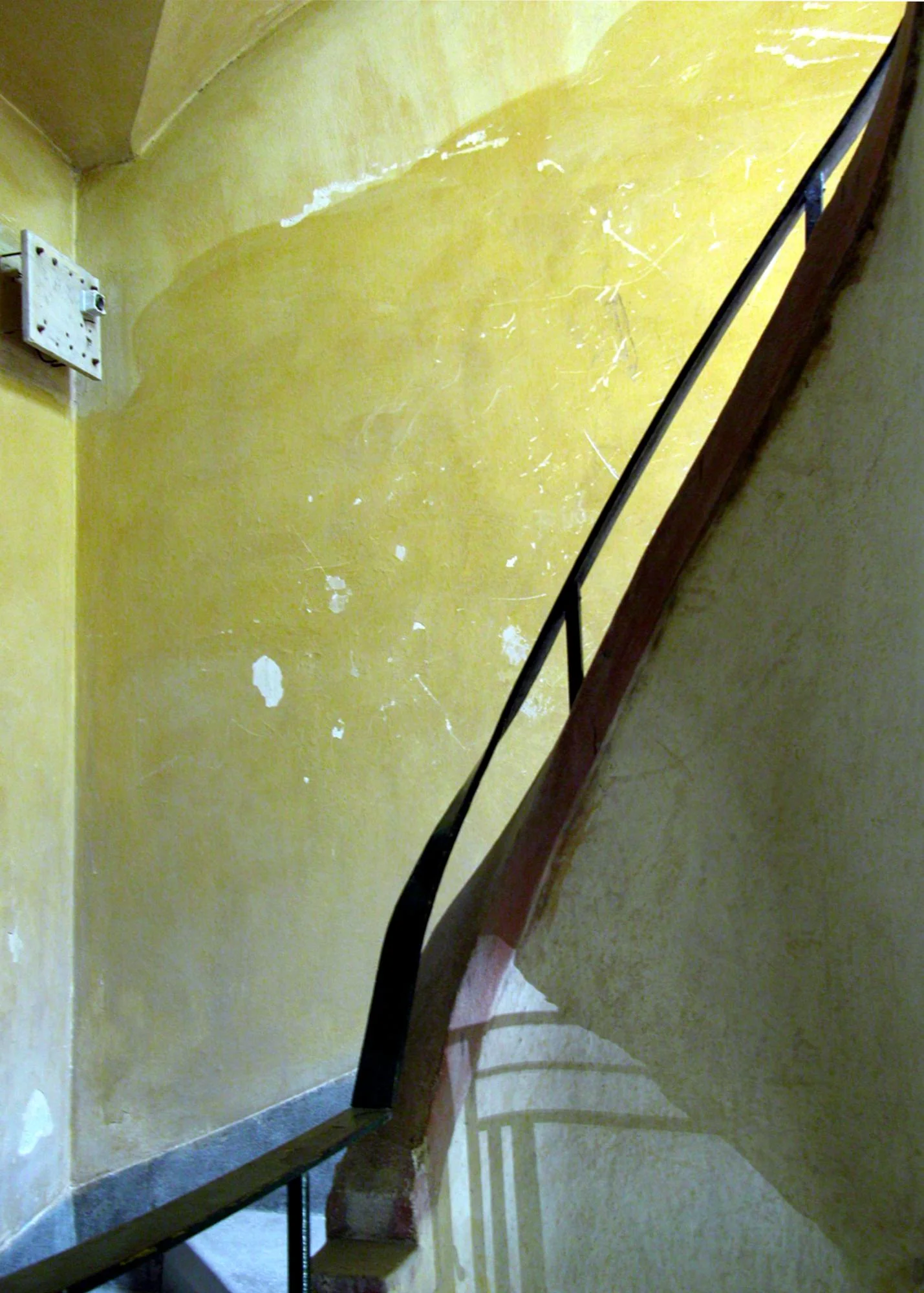
This particular modernist building may be interesting in its own right: those molded staircases, for instance, with their unduly tin handrails seem to provide an organic core to the building. The history of the property is also piquant, for it seems to have fallen from grace and to have been used as temporary housing. I doubt, thought, if the pictures on show here are those of a documentarist, even if they are appreciative of some of the finer points of the buildings.
One likelihood is that Kleopatra Haritou has used the buildings for an examination of several varieties of art. Photography has always lent itself to investigations, and this a case in coin. The pictures of the elegant staircase, for example, with its elegant curves and tinted planes make up an enquiry to modernism – of the kind practiced by in the 1920s and ‘30s by Edward Weston. Active in California and in Mexico, Weston took pictures of sand dunes, rippled and sharp edged. The modernist intention, expressed in such pictures, seems to have been to register the fall of light very exactly with close attention to gradation and tone. With sand, rock or painted plaster Weston and his contemporaries managed to make pictures that were like largely about seeing, detached from empirical subject matter. They were Purists. Some of the stairwell pictures in this collection refer back to the aesthetic values of Weston and his contemporaries. The difference is that these new pictures are in colour. In some cases, there are sharp tonal contrasts along with areas of darkness. Where the pictures of 1930 were often refined abstracts these are in some cases too, disrupted and melodramatic. What she has done is to take a well-groomed aesthetic format and to invest it with memories of the internal and even the intestinal: an endoscopic variant on a modernist theme, that is to say.
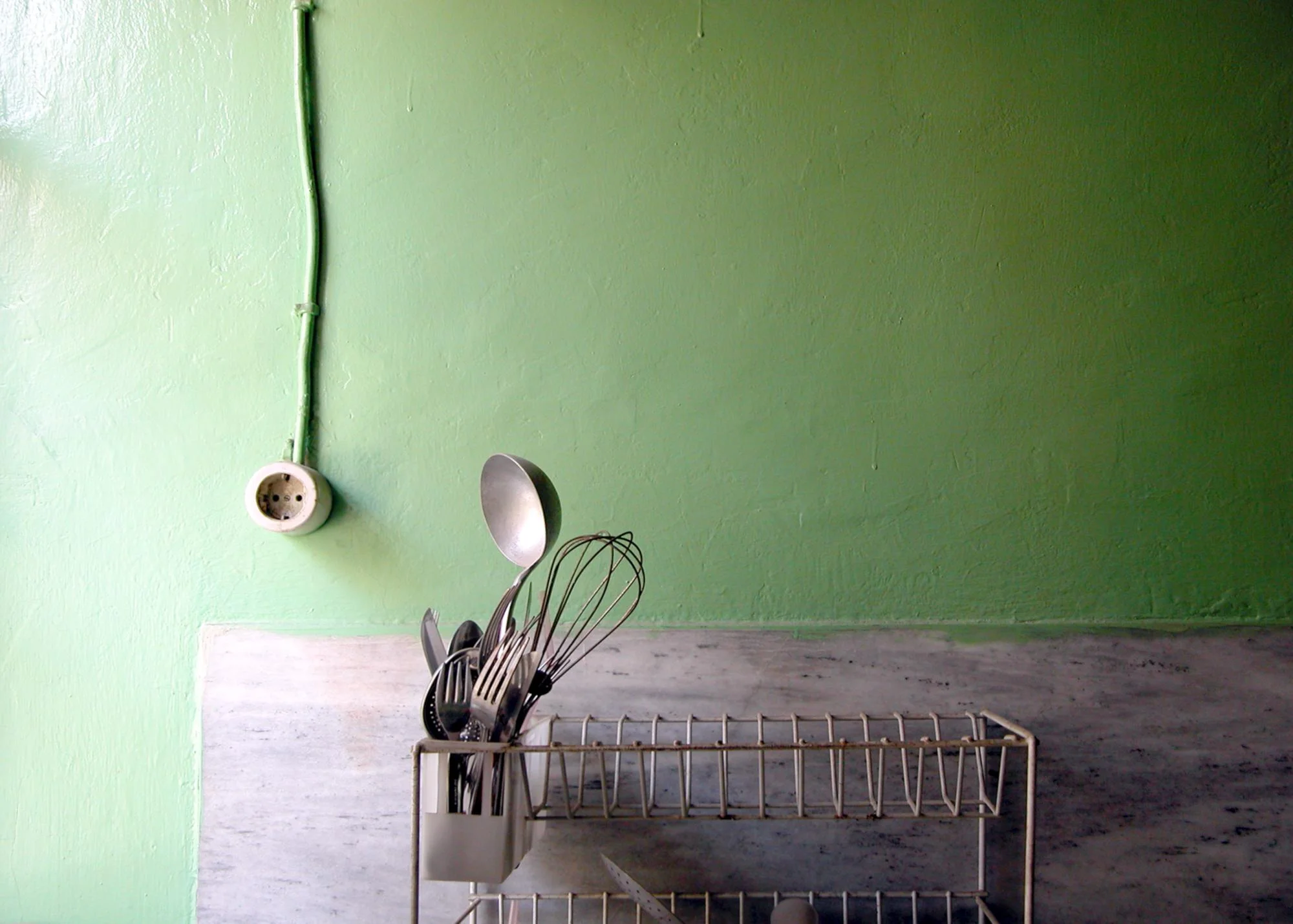
The pictures of the stairwells remind us of the purist tendency in modernism. They invoke a period when photographers were intent on art and not just on documentation. They remind us that art is at issue, and that everything else on show might be considered through art’s filter – no matter how disorderly and random. Why, for instance, take a picture of a table top with a few domestic items under a light covering of dust? Well, a table top or any flat supportive surface presents us with objects ready for use: a pan, a cup or a framed photograph to be picked up for inspection. Usually we look down on work surfaces, and to see them from any other angle is worthy of comment. Why, then, has she stooped to take a picture of a table top or crouched to bring herself level with items placed on the floor? Maybe she was remembering Giorgio Morandi, whose carefully placed still life items register his point of view, standing and scrutinizing. What these images do is to emphasize standpoint, and to make sure that it is not overlooked. There is, she seems to suggest something like an ideal or an innate standpoint for different kinds of things. On the staircase we look up and down, for this is where the steps lead, and we look towards the handrail which is our support in such an unstable setting. We place ourselves appropriately to look into a cupboard, at a screen, through a window or at a book. Perhaps, the pictures suggest, there is an etiquette governing all those things which we come across on a daily basis. Up to the present, thought, we have taken all this for granted. Morandi’s scrupulous placing of vessels, pots and pans on his studio table was a pointer in this direction, but he didn’t insist, preferring that we took in the implication subliminally. What Kleopatra Haritou does, by contrast, is to remark on standpoint as a topic. things, as it were, impose themselves on her according to rules of their own: even wallpaper, for example, has its format- an undifferentiated planar look.
These pictures propose that objects solicit us in their different ways. We address windows on an equal footing, for they give us light and make openings into the rest of the world out there. Towards chairs and beds, though, we incline, for they await for our bodies. Pictures and portraits, surrogates for the human presence, keep us at a respectful distance, but we approach books the better to make them out and to pick them up. These pictures of “The refugee settlements of Alexandra’s Avenue” are ostensibly records of an interesting place, but their real purpose is to introduce us to the presence of the photographer, our representative who acts on our behalf, peering, craning, stooping, and reaching. The series amounts to photography as a kind of proxy sculpture, for the hidden subject is the photographer herself, not as a controlling intelligence but as animated substance managed by this particular place. Following her tracks, up the twisted staircase and into the sparsely furnished rooms; we have no choice but to mimic her gestures, in imagination at least.
They are strenuous images, cunningly set out. They oblige us to make an effort, to look closely, for instance at pale spaces on a wall to discern just where the traces are. Furniture, as if making its own comments on the task of approaching the scene, might be pressed together, turned or placed as a barrier, impeding access. If you were to walk into such a space you would have to watch your step. They may look like photographs but at the same time they act as diagrams, guiding our approach, and in one instance she even features a pair of crutches, an ultimate aid to movement in difficult conditions.
It is most unusual to find photography that reminds us of how we approach a book, say, or a door or a window. Generally in photographs we are ascend with cultural data and pieces of evidence that we can put together to get some impression of life and times. In the history of painting, however, there are examples of the kind of art practiced by Kleopatra Haritou. Looking at J.L. David’s “Marat assassiné” (1793) you will find yourself imitating the set of Marat’s head should you try to read the inscription on the letter held in his left hand. The Marat scene is the best example of this kind of imitative procedure I can think of in painting, although there are many others. They abound in Titian’s paintings, for example: those torturers who feel the heat in the Martyrdom of St. Lawrence are good instances.
I doubt if kleopatra Haritou feels that it is her duty to make us remember just what it is like to ascend a vertiginous staircase or to approach a chair. It is probably just a feature of her art that she is engrossed by the kinetics of the body and its objects, and that the buildings on Alexandra’s Avenue provided her with a perfect theater of operations.
ACROBATS, by Kleopatra Haritou
2016
The entrance to the drug-infested areas of central Athens is clearly visible to everyone. I begin to explore these places, confronting the city as a unified entity. Its veins and arteries pulse in sync, yet meaningful connection is absent. There is a mutual fear among its inhabitants.
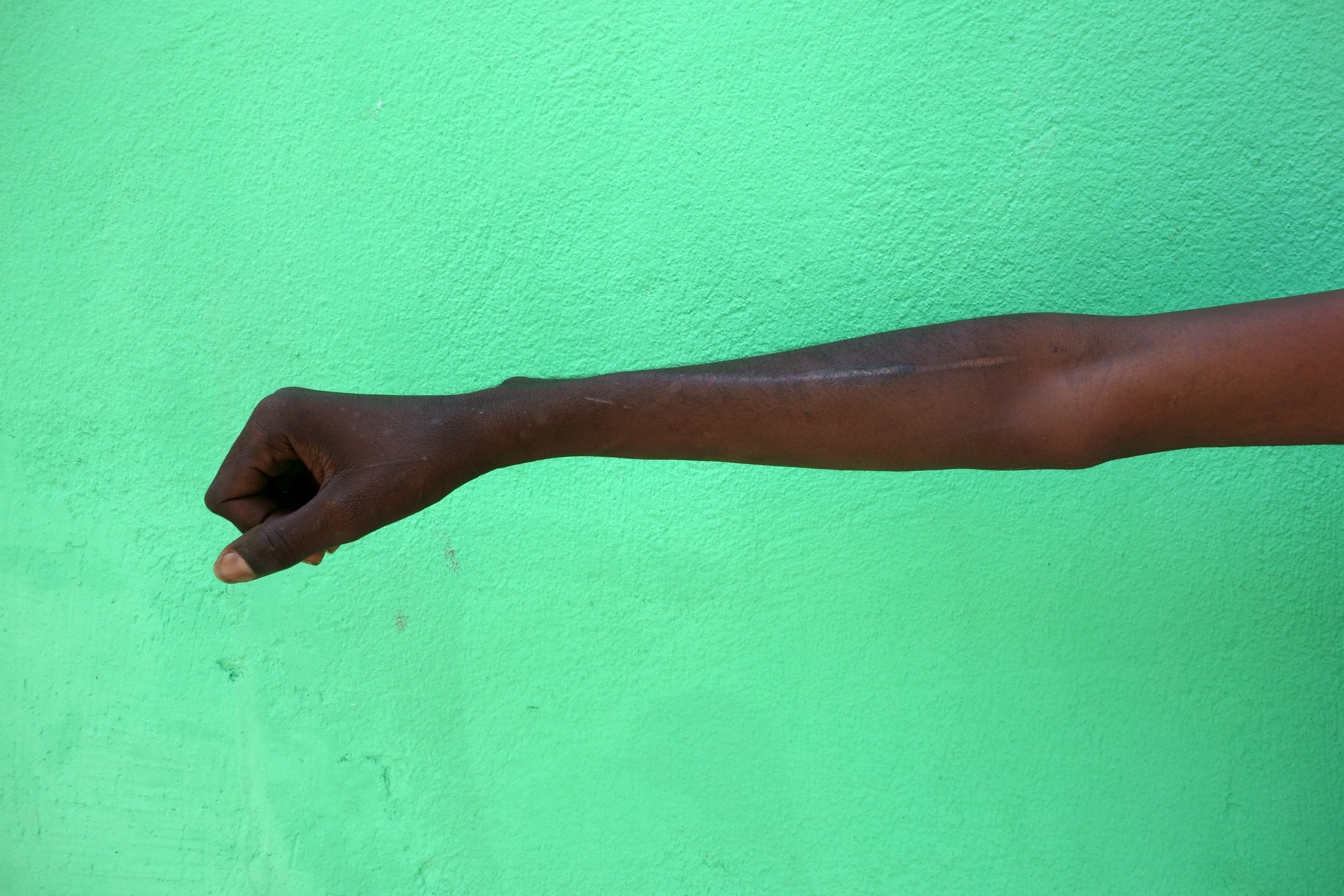
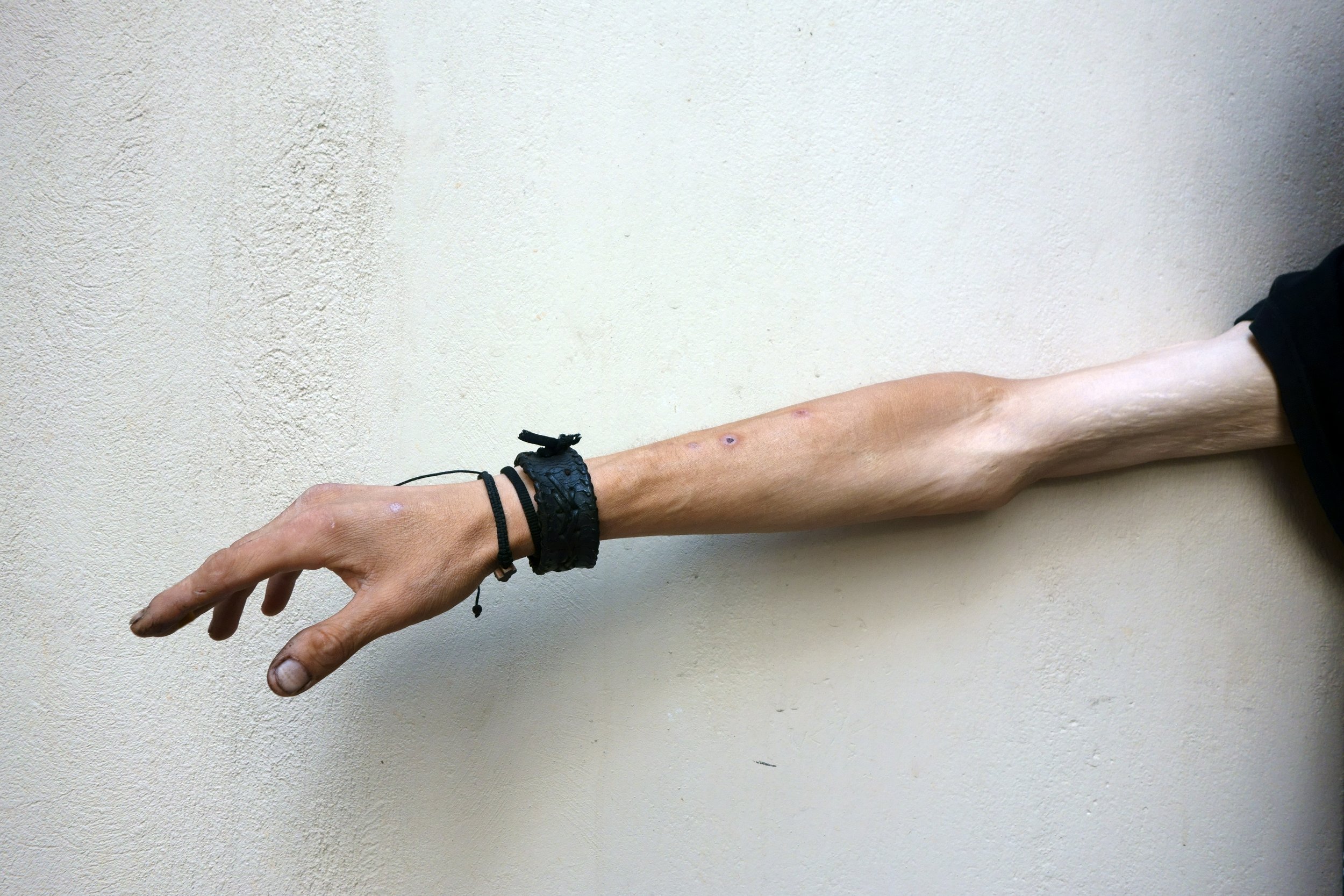
The veins represent the homeless, the Acrobats, and all those struggling with addiction. Society views them as the bearers of tainted blood within the city’s core. Their existence hangs by a thread, reliant on a fleeting moment of escape. What more do they have to lose? Their aspirations and dreams are intertwined with harmful substances, injected into their lives daily. They are painfully aware of their social standing; their only gamble is on dependency, hoping that the desire for life remains dormant, as it appears to lead only to suffering.
The arteries are the everyday citizens, who pass by the drug hotspots without acknowledging the Acrobats. They breathe in fear whenever the specter of death looms over life. Terrified that surrender might infiltrate their own lives, they continuously seek a miraculous solution. Death must be banished. The nameless Acrobats reflect the underlying, absurd anxiety of their own potential downfall, as well as that of the city. Mrs. Lucas frequently calls the police, demanding they remove them, as their presence deeply disturbs her.
At 5:00 pm in Omonoia Square, female addicts exchange sex for sisa, often ending up assaulted in plain sight. There are no tears, no fear—only self-pity when their oxygen-starved minds yearn for the children they’ve lost to asylums. How ironic! Sisa is made from battery acid, the same substance used in toy cars. Some Acrobats have legs that are decayed, resembling broken dolls. They find shelter in burrows within a central park in Athens. Their eyes are vacant, their minds shattered, their skin struggles to cover their bones, and their stiff bodies freeze in a sculptural pose beneath the warm glow of streetlights.
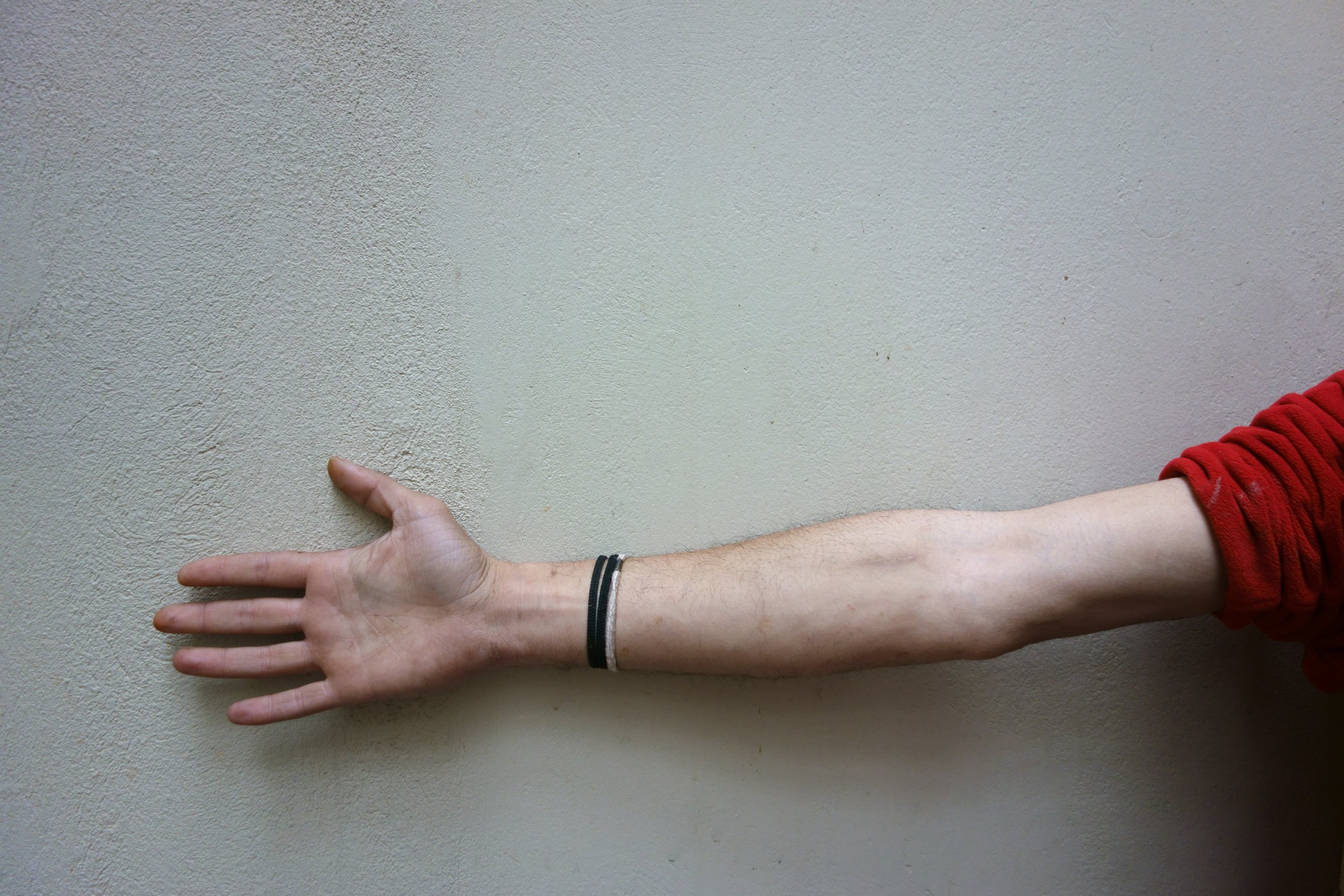
The Acrobats are generally kind to me, offering apologies and gratitude.The Acrobates show me kindness, often expressing their apologies and gratitude. They seem embarrassed and request that I keep my distance. Their bodies are marked with blood stains, and the shadow of HIV looms large. It takes a significant amount of strength to process this harsh reality. These human figures exist in darkness, yet my instinct compels me to extend a helping hand. Ultimately, I can only describe the weary young boy clutching a box wrapped in paper adorned with colorful roses. I long to portray the girl with her decaying nails, matching the hue of her bracelet, as she navigates her fragile wrist. These are signs of dignity, yet all I hear are terms like imprisonment, exile, infringement, and divergence.
As I sleep at night, both worlds invade my dreams, pleading for order, lest the dawn finds me cursed. Who can bring about justice? No answers seem to lead to peace. In this school of death, there are no instructors.
The economic turmoil in Greece exacerbates the situation to its limits. Like the cells of a newborn, the wounds in the heart of the city continue to multiply. HIV, psychotic episodes, and aggressive behavior from steroid abuse drive addicts to display violent tendencies, even against their peers, all for a fleeting high. Yet, hate soon transforms into empathy, and they reach out for help; a new vein for injection becomes their shared territory.
I ascend to gain a bird's-eye view of my city. Its depths are filled with numerous drug-infested corners. The wounds are gaping. A portion of Athens is slowly succumbing to the effects of cheap, toxic substances, while another segment is in a constant state of protest. I hear the sound of a caravan bursting forth. New generations are rising, their voices louder than ever, now also demanding action on the environmental crisis. A cold light bathes the Parthenon, which stands resolutely amidst its decay. In the city's clamor, I can hear the Parthenon’s breath, reminiscent of a housewife left alone to iron clothes in the sweltering heat of mid-August. Democracy appears fragile as I gaze upon it.
I ascend to a high vantage point to gaze down at my city. Its depths are marked by numerous street corners where drugs thrive, leaving the city wounded and bleeding. A segment of Athens is trapped in a cycle of self-destruction through the use of cheap, harmful substances. Meanwhile, another faction is in a constant state of protest. I can hear the echoes of a caravan bursting forth, as new generations raise their voices even louder, now also demanding action on the environmental crisis. The cold light cascades over the Parthenon, which stands resolutely, weathered but proud. Amidst the city's hustle and bustle, I can almost hear the Parthenon’s breath, reminiscent of a housewife left alone to tackle the family laundry in the sweltering heat of August. Democracy feels fragile as I survey the apartment buildings, which rise like skeletal structures in a state of disarray, segregating themselves into camps of futile ideologies: Are you Christian? Are you straight? Are you white?
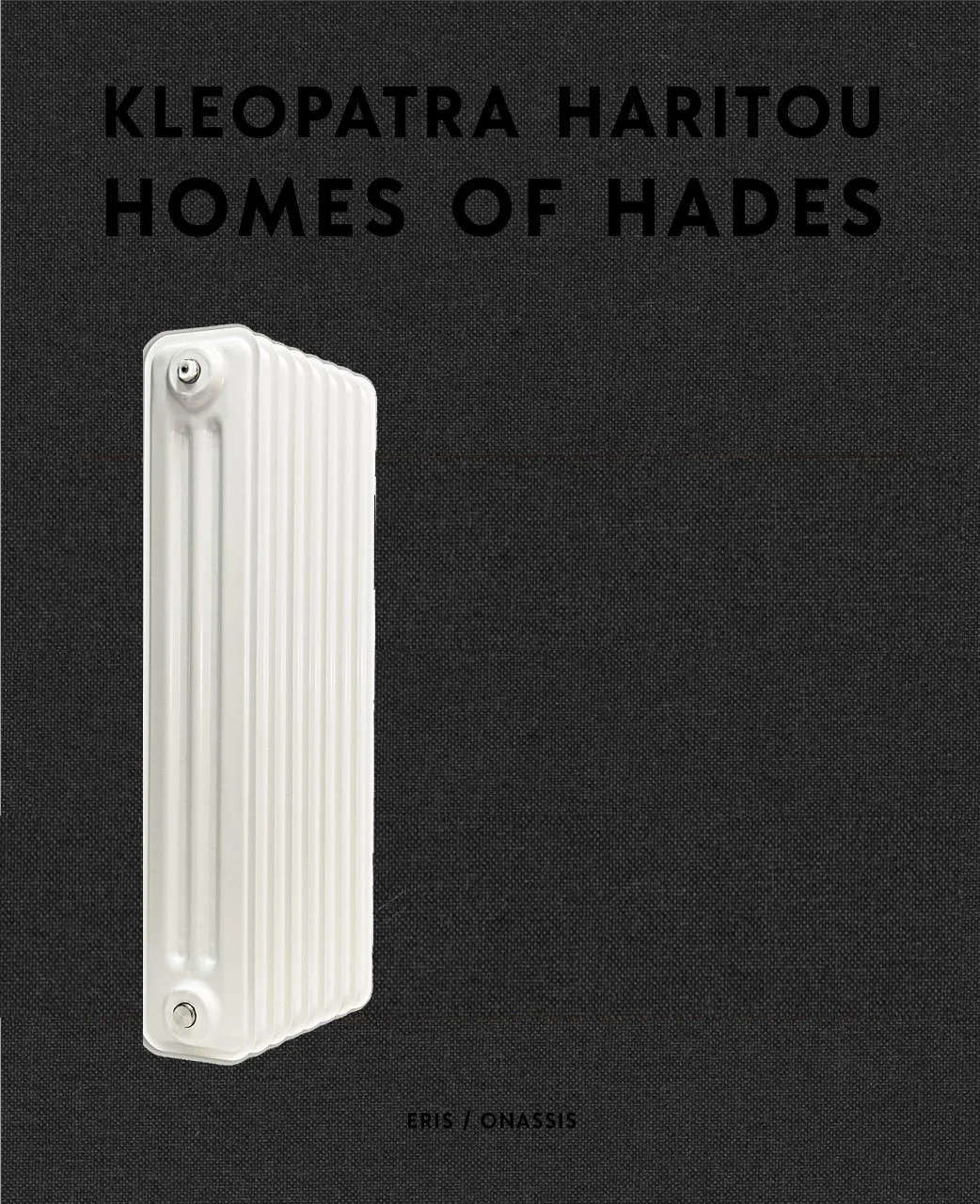
“HOMES of HADES”
Publication in progress
“Death is insignificantly divergent from life”
- Thales of Miletus
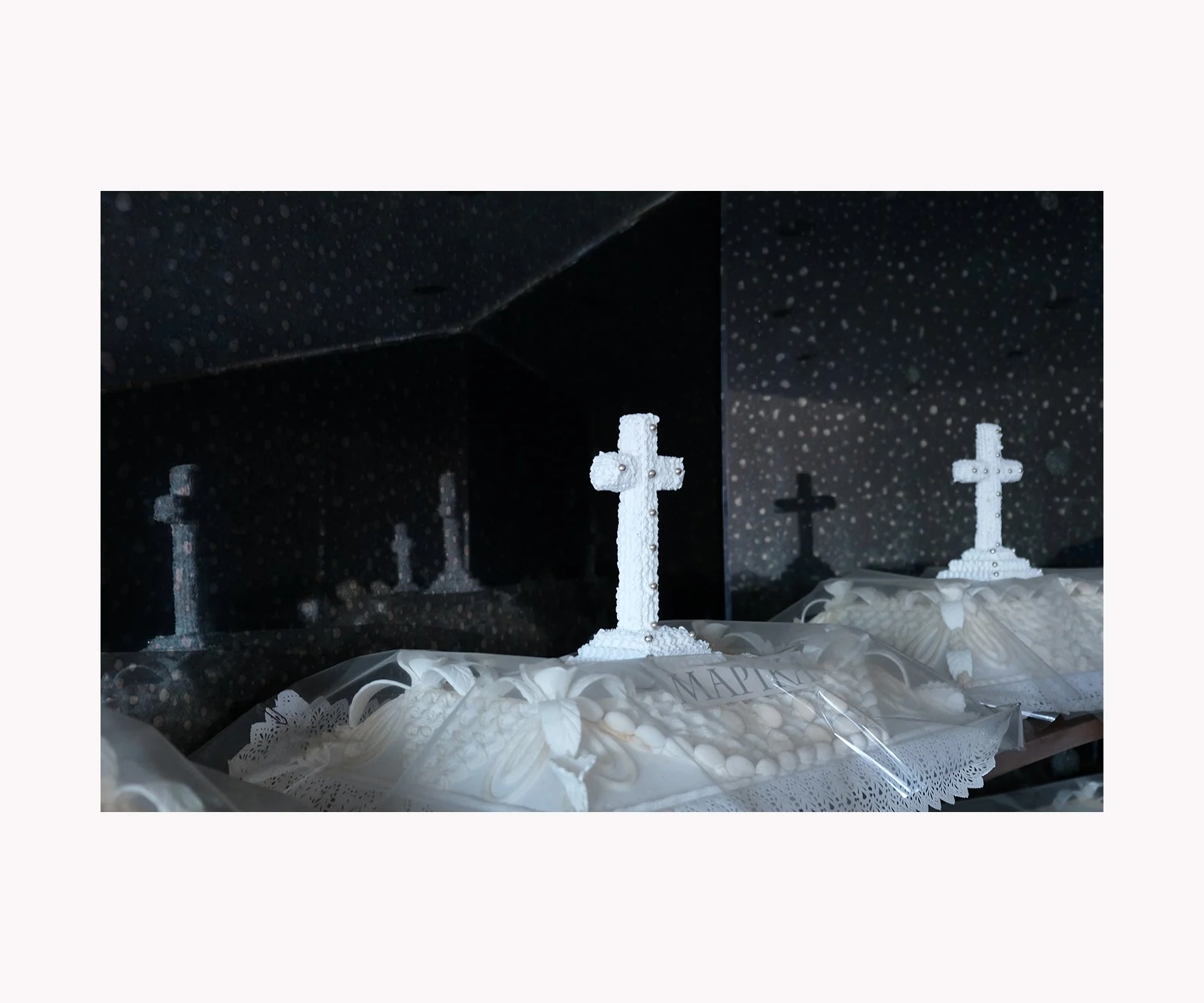
An ongoing edition for the burial landscape of Tinos island
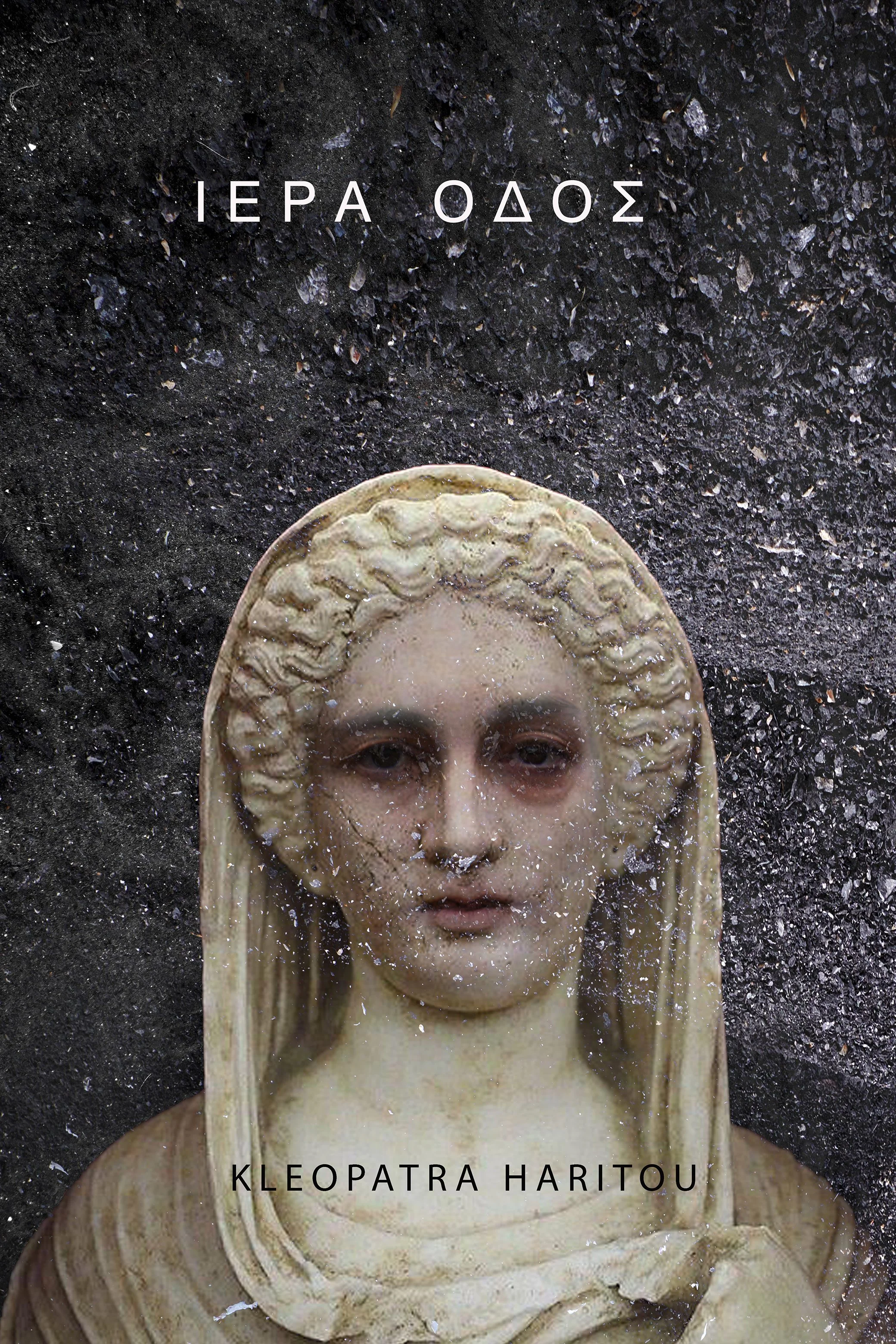
The film "IERA ODOS" is an essay film/hybrid documentary on the modern Sacred Rd. (IERA ODOS), one of the oldest roads of Europe.
Drawing on the myth of Persephone, a mythical woman whose life is entirely defined by others -the husband, the mother and the humans - the film follows this modern protagonist as she crosses the Sacred Rd. in order to bring Spring upon earth, once again, during the Anthropocene era. The distance from the one edge of Sacred Rd. to the other, is defined as the intermediate distance from the underworld (Kerameikos) to the surface of earth (Eleusis).
The woman becomes the road, revealing also the difficulties and challenges women face towards their independence and equality.
Direction: Kleopatra Haritou
Production: Kalibu
Funded by: EKOMED and Hellenic Broadcasting Corporation
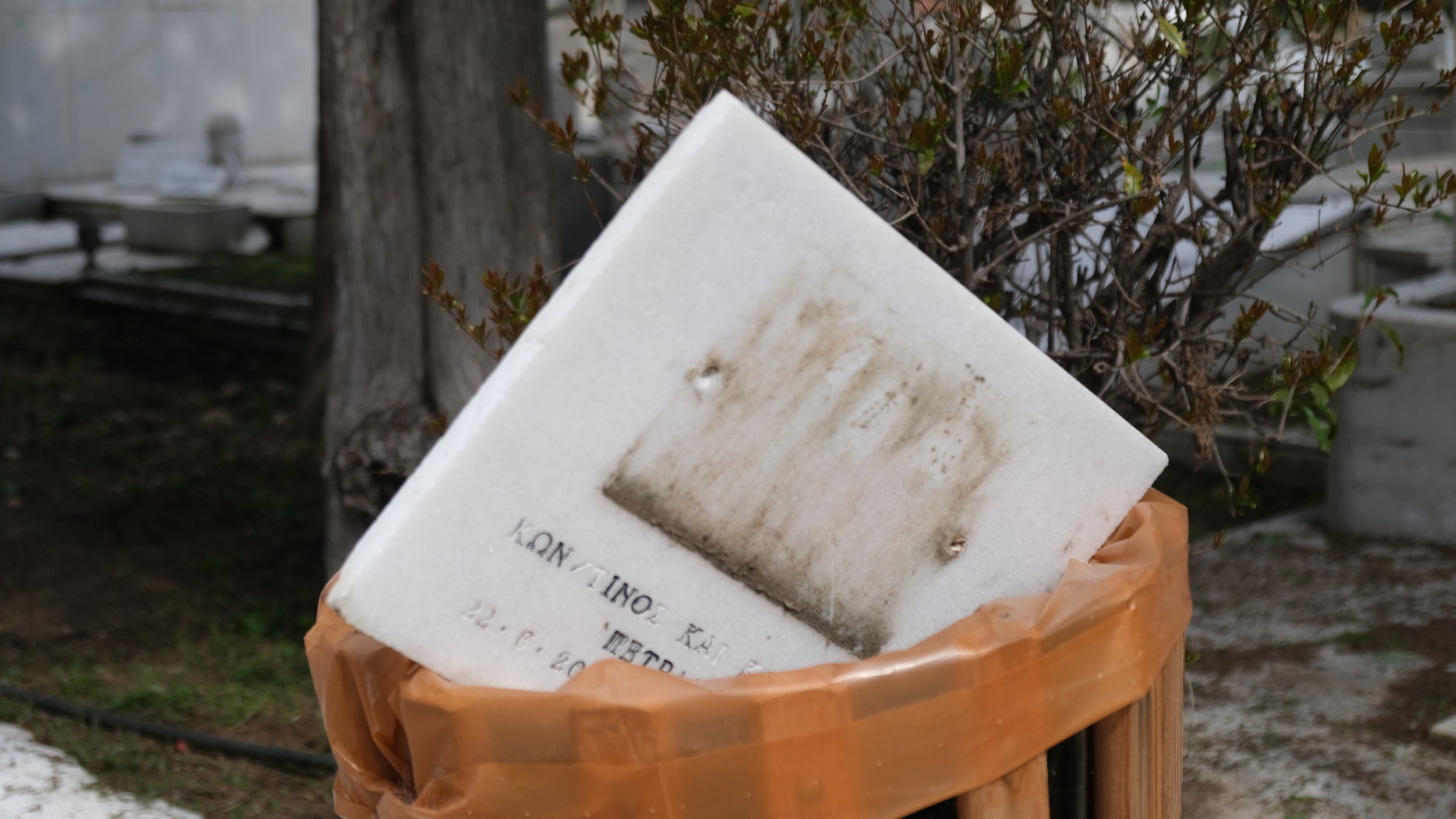
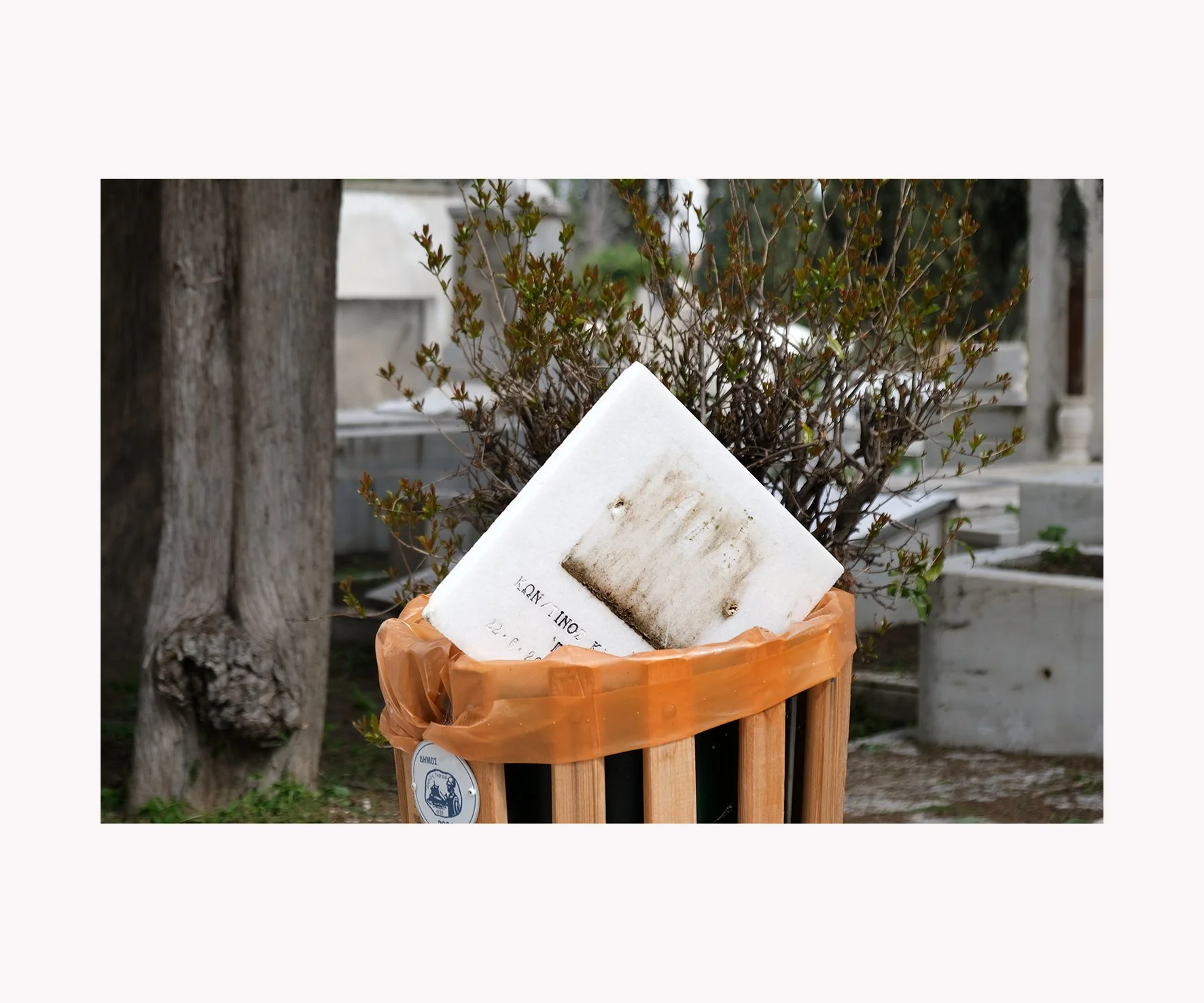
During the Anthropocene, the promise of resting in peace in Greece, within the industry of grief, collapses as the majority of dead are forced to return after only 3 years, even in pieces.
Synopsis:
Inspired by the structure of The Divine Comedy by Botticelli the film REST IN PIECES is moving through tradition, industry, cemetery infrastructures, and labor, tracing a quiet collapse. In a system where graves are by force cleared after three years, poor& overused soil meets chemically saturated bodies -by pharmaceuticals and microplastics- making decomposition impossible. Revealing a growing deadlock between institutional systems and the limits of the Anthropocene booming in urban cities, and as local research remains limited, the film turns to international expertise for emerging technologies and solutions.
“The Praying Mantis”, a documentary in progress, on the commercialization of the burial landscape and the civil rights of the deceased in Greece.